Conversation with the Atlantean Children of The Law of One — Part 9
The Will of The Universal Spirit
Question: You have explained that when you descended into this lower dimension, you did not possess ‘free will’ and lacked any form of compassion or emotions. Is this accurate?
Answer: In the universe, there are principles and different laws that come into play during creation. When the grand reality unfolds, giving birth to multiple realities and worlds, it generates adjacent realities. These adjacent realities, although they may be distant from one another, still influence each other.
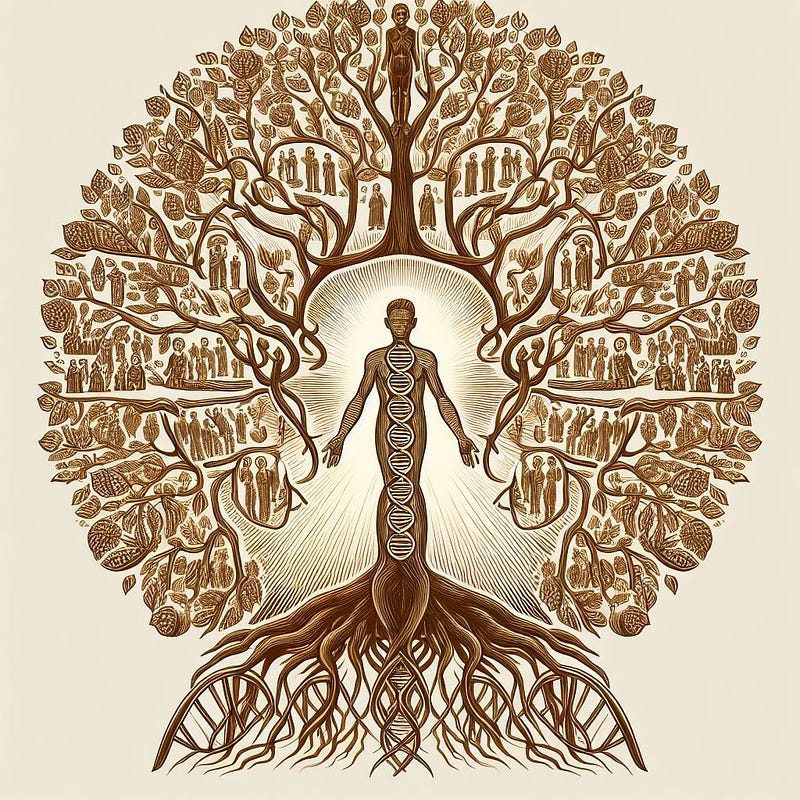
Just as an example, consider ancestry: your present existence is a direct result of your ancestors’ existence. While you possess an independent will and life, and so did they, you remain interconnected. On a linear timeline, your existence would not be possible without your ancestors, and the way they lived during their era affects your current existence in numerous ways.
We did have The Will to choose, but it operated within certain restrictions, not as you understand the concept of free will. However, when we distanced ourselves from our original reality, our scope for creating and choosing expanded significantly.
For example: imagine a group of humans sent to a remote planet to start anew. Upon their arrival, their freedom is boundless, and most moral obligations and rules that carry consequences on Earth have little relevance. They can act as they please without fear of repercussions.
This analogy illustrates how we did not view the inhabitants of this realm as equals. Much like how people on Earth interact with plants, inanimate objects, and animals — often conducting experiments or using them without a profound sense of moral obligation or a compassion.
Hence, the dichotomy between strong-willed individuals who stop at nothing to fulfill their desires and empathetic individuals who demonstrate consideration and compassion for all life persists to this day. This ancient conflict, induced by our arrival, represents a longstanding disharmony in your heritage.
By interfering with any ecosystems, you establish connections and relationships. When we disrupted these ecosystems, we automatically became entangled with them and became part of their ecosystem.
For instance, consider the Zoos. These animals are taken from their natural ecosystems, and when you adopt an animal, you become responsible for their well-being. You provide them with food, medical, and shelter, essentially taking over the role of their ecosystem. Then after a while these animals will not be able to go back to their natural ecosystems again because their habits have been modified. This kind of interaction tied us to the native inhabitants at the time and bound them to us.
This principle helps explain the conflicts and connections you encounter in life. If you look at situations from this perspective, you might realize that at some point, you might have interfered with a certain system, thus becoming part of it. It sheds light on issues like immigration and the need to belong. It also clarifies why you might find yourself entangled with certain family members, friends, or society members.
The key to resolving these entanglements is through acceptance and compassion. By accepting an individual holistically and ‘let them be’ without violating each other’s will, then there will be harmony.
Imagine your life’s path as a journey. If you encounter a mountain or huge obstacle along the way, it’s often easier to navigate around it than to attempt to remove the mountain itself. Trying to clear the path or remove the obstacle can be an incredibly laborious task, whereas simply finding a way around it is more practical.
For thousands of years, this fundamental principle shaped societies: the presence of boundaries and borders. Within these societies, individuals respected these borders and only crossed them when there were particular needs or trade interactions. There was a deep understanding that these borders were not just physical but also governed by higher principles.
People knew that crossing certain geographical landmarks, like a great river or a vast desert, carried significant consequences. Phrases like “if you cross a great river, don’t come back” or “if you cross the great desert, you will die” were used to emphasize the importance of staying within their own ecosystems. This practice aimed to prevent the introduction of diseases and unfamiliar challenges into their living areas.
Question: You have mentioned the conflict and your escape from your angelic states when descending. Can you provide more insight into this?
Answer: We’ve discussed the Will of the Creators or Universal Spirit. It’s important to understand that the path of existence isn’t always a steady ascent toward perfection. Even higher beings can experience declines and falls. When this occurs, it can lead to conflicts or what might be referred to as a “War in Heaven.” This phenomenon primarily occurs during the Harmonic Convergence, where different portals open, allowing negative entities to rise and prompting celestial warriors to engage in battle.
Negative entities seek to infiltrate and disrupt the established order. As a result, there may be a need to escape or take cover. Our descent into your realm was a response to this chaotic event, which was part of another hyperdimensional universe, of which your universe was a part. The opening of these gates led some of us to venture into these lower realms, and we were trapped in them. Subsequently, we made the choice to descend and attempt to save those affected.
In summary, these periods of upheaval occur, and upon experiencing them, we have come to understand that they are expressions of the Will of the Universal Spirit. The outcomes of such events hold meaning and purpose, stimulating growth in various ways.
Conversation with the Atlantean Children of The Law of One — Part 9
The Will of The Universal Spirit
Question: You have explained that when you descended into this lower dimension, you did not possess ‘free will’ and lacked any form of compassion or emotions. Is this accurate?
Answer: In the universe, there are principles and different laws that come into play during creation. When the grand reality unfolds, giving birth to multiple realities and worlds, it generates adjacent realities. These adjacent realities, although they may be distant from one another, still influence each other.
Just as an example, consider ancestry: your present existence is a direct result of your ancestors’ existence. While you possess an independent will and life, and so did they, you remain interconnected. On a linear timeline, your existence would not be possible without your ancestors, and the way they lived during their era affects your current existence in numerous ways.
We did have The Will to choose, but it operated within certain restrictions, not as you understand the concept of free will. However, when we distanced ourselves from our original reality, our scope for creating and choosing expanded significantly.
For example: imagine a group of humans sent to a remote planet to start anew. Upon their arrival, their freedom is boundless, and most moral obligations and rules that carry consequences on Earth have little relevance. They can act as they please without fear of repercussions.
This analogy illustrates how we did not view the inhabitants of this realm as equals. Much like how people on Earth interact with plants, inanimate objects, and animals — often conducting experiments or using them without a profound sense of moral obligation or a compassion.
Hence, the dichotomy between strong-willed individuals who stop at nothing to fulfill their desires and empathetic individuals who demonstrate consideration and compassion for all life persists to this day. This ancient conflict, induced by our arrival, represents a longstanding disharmony in your heritage.
By interfering with any ecosystems, you establish connections and relationships. When we disrupted these ecosystems, we automatically became entangled with them and became part of their ecosystem.
For instance, consider the Zoos. These animals are taken from their natural ecosystems, and when you adopt an animal, you become responsible for their well-being. You provide them with food, medical, and shelter, essentially taking over the role of their ecosystem. Then after a while these animals will not be able to go back to their natural ecosystems again because their habits have been modified. This kind of interaction tied us to the native inhabitants at the time and bound them to us.
This principle helps explain the conflicts and connections you encounter in life. If you look at situations from this perspective, you might realize that at some point, you might have interfered with a certain system, thus becoming part of it. It sheds light on issues like immigration and the need to belong. It also clarifies why you might find yourself entangled with certain family members, friends, or society members.
The key to resolving these entanglements is through acceptance and compassion. By accepting an individual holistically and ‘let them be’ without violating each other’s will, then there will be harmony.
Imagine your life’s path as a journey. If you encounter a mountain or huge obstacle along the way, it’s often easier to navigate around it than to attempt to remove the mountain itself. Trying to clear the path or remove the obstacle can be an incredibly laborious task, whereas simply finding a way around it is more practical.
For thousands of years, this fundamental principle shaped societies: the presence of boundaries and borders. Within these societies, individuals respected these borders and only crossed them when there were particular needs or trade interactions. There was a deep understanding that these borders were not just physical but also governed by higher principles.
People knew that crossing certain geographical landmarks, like a great river or a vast desert, carried significant consequences. Phrases like “if you cross a great river, don’t come back” or “if you cross the great desert, you will die” were used to emphasize the importance of staying within their own ecosystems. This practice aimed to prevent the introduction of diseases and unfamiliar challenges into their living areas.
Question: You have mentioned the conflict and your escape from your angelic states when descending. Can you provide more insight into this?
Answer: We’ve discussed the Will of the Creators or Universal Spirit. It’s important to understand that the path of existence isn’t always a steady ascent toward perfection. Even higher beings can experience declines and falls. When this occurs, it can lead to conflicts or what might be referred to as a “War in Heaven.” This phenomenon primarily occurs during the Harmonic Convergence, where different portals open, allowing negative entities to rise and prompting celestial warriors to engage in battle.
Negative entities seek to infiltrate and disrupt the established order. As a result, there may be a need to escape or take cover. Our descent into your realm was a response to this chaotic event, which was part of another hyperdimensional universe, of which your universe was a part. The opening of these gates led some of us to venture into these lower realms, and we were trapped in them. Subsequently, we made the choice to descend and attempt to save those affected.
In summary, these periods of upheaval occur, and upon experiencing them, we have come to understand that they are expressions of the Will of the Universal Spirit. The outcomes of such events hold meaning and purpose, stimulating growth in various ways.
Leave a Reply