
Conversation with the Great Earth Spirit — GAIA — Part 14
Redefining Evolution
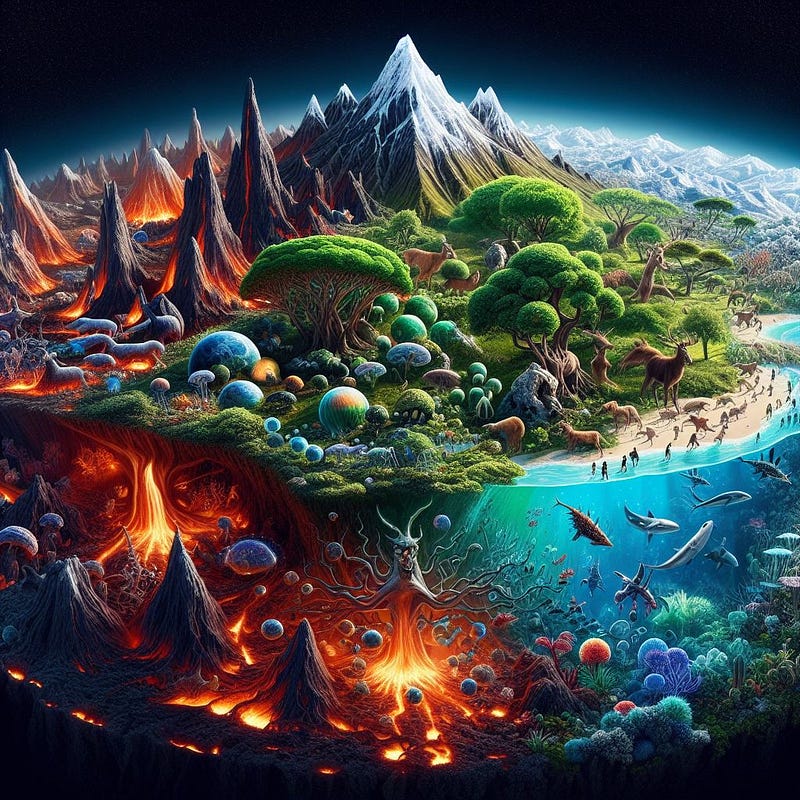
When we discuss evolutionary creatures, we’re exploring the diverse processes of growth within an ecosystem. This means that as life manifests in physical reality, it undergoes distinct progressive stages and cycles. Just like an embryo progresses through various stages to reach maturity within the womb, before embarking on the new cycle of life after birth, ecosystems also evolve.
Typically, ecosystems begin with simple life forms — basic plants, animals, and other organisms. This initial period, after lasting for a certain time, gives way to increased complexity. Plant life diversifies, creatures become more intricate, and even soil systems and cycles evolve into more elaborate forms.
During these transformations, an entire ecosystem might appear to have vanished, as if succumbing to extinction. However, it has often simply transformed into a new type of system. The essence of the animals and plants is preserved, while their biological systems are reconstructed and “upgraded.” This isn’t a one-way street either; a process of “de-evolution” exists where elements of complex systems can decline and revert to simpler forms. This pattern extends even to planets, where a seemingly lifeless planet in one dimension may teem with life in another, operating at a different pace of motion and time.
Forests exemplify this progression beautifully. They begin as simple systems of shrubs, evolving into bushes, then basic forests, mature forests, and ultimately, super-forests. In your current civilization, no one has witnessed a truly complete ecosystem. Even what you consider a grand forest, like the Amazon Jungle, pales in comparison to the true “Forest stage” of development, let alone the astounding diversity and complexity of a super-forest.
At one stage of development, the concept of one animal consuming another is nonexistent. It is only when different stages of ecosystems interact that this phenomenon emerges. What we perceive as “nature” today is not in its purest form, but rather a remnant of its once flourishing state.
This process of transformation between ecosystem stages has been misinterpreted as evolution. The sudden bursts of change and the emergence of new species have puzzled scientists, as they struggle to comprehend the mechanisms behind such dramatic shifts.
If any survivors from an earlier ecosystem persist, they may find it impossible to adapt to the complexities of the succeeding one. This incompatibility leads to scenarios where one type of animal preys on another, simply because they are not equipped for the new environment.
Therefore, when King Ur arrived, his biological makeup was attuned to a more advanced ecosystem than what existed on this world at that time. This disparity caused chaos, as the two ecosystems were incompatible.
The next time you encounter ancient structures, remember the profound changes that have transpired. And when you immerse yourself in nature, recognize that you are not only part of an ancient system, but also a participant in an eternal, ever-evolving one.
Conversation with the Great Earth Spirit — GAIA — Part 14
Redefining Evolution
When we discuss evolutionary creatures, we’re exploring the diverse processes of growth within an ecosystem. This means that as life manifests in physical reality, it undergoes distinct progressive stages and cycles. Just like an embryo progresses through various stages to reach maturity within the womb, before embarking on the new cycle of life after birth, ecosystems also evolve.
Typically, ecosystems begin with simple life forms — basic plants, animals, and other organisms. This initial period, after lasting for a certain time, gives way to increased complexity. Plant life diversifies, creatures become more intricate, and even soil systems and cycles evolve into more elaborate forms.
During these transformations, an entire ecosystem might appear to have vanished, as if succumbing to extinction. However, it has often simply transformed into a new type of system. The essence of the animals and plants is preserved, while their biological systems are reconstructed and “upgraded.” This isn’t a one-way street either; a process of “de-evolution” exists where elements of complex systems can decline and revert to simpler forms. This pattern extends even to planets, where a seemingly lifeless planet in one dimension may teem with life in another, operating at a different pace of motion and time.
Forests exemplify this progression beautifully. They begin as simple systems of shrubs, evolving into bushes, then basic forests, mature forests, and ultimately, super-forests. In your current civilization, no one has witnessed a truly complete ecosystem. Even what you consider a grand forest, like the Amazon Jungle, pales in comparison to the true “Forest stage” of development, let alone the astounding diversity and complexity of a super-forest.
At one stage of development, the concept of one animal consuming another is nonexistent. It is only when different stages of ecosystems interact that this phenomenon emerges. What we perceive as “nature” today is not in its purest form, but rather a remnant of its once flourishing state.
This process of transformation between ecosystem stages has been misinterpreted as evolution. The sudden bursts of change and the emergence of new species have puzzled scientists, as they struggle to comprehend the mechanisms behind such dramatic shifts.
If any survivors from an earlier ecosystem persist, they may find it impossible to adapt to the complexities of the succeeding one. This incompatibility leads to scenarios where one type of animal preys on another, simply because they are not equipped for the new environment.
Therefore, when King Ur arrived, his biological makeup was attuned to a more advanced ecosystem than what existed on this world at that time. This disparity caused chaos, as the two ecosystems were incompatible.
The next time you encounter ancient structures, remember the profound changes that have transpired. And when you immerse yourself in nature, recognize that you are not only part of an ancient system, but also a participant in an eternal, ever-evolving one.
Leave a Reply