Did Nikolai A. Kozyrev Built a Time Machine?
The Soviet scientist who understood the nature of time
Introduction:
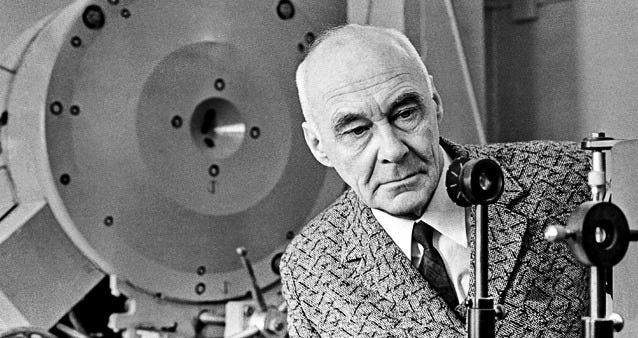
Nikolai Alexandrovich Kozyrev (1908–1983) was a prominent Russian astronomer, astrophysicist, and pioneer in the field of time research. Kozyrev’s groundbreaking experiments and theories challenged conventional scientific understanding and explored the interconnectedness of time, space, and energy.
His work has had a profound influence on fields such as cosmology, physics, and parapsychology. This article delves into the life, experiments, and contributions of Nikolai A. Kozyrev.
Kozyrev’s Life and Work
Nikolai Kozyrev was born on September 2, 1908, in Saint Petersburg, Russia. From an early age, he displayed a keen interest in natural sciences and pursued his passion for understanding the mysteries of the universe. In 1925. Kozyrev’s insatiable curiosity led him to explore various scientific disciplines, including astronomy and astrophysics.
In his studies he pursues astronomy and physics and graduated from Leningrad State University in 1931 with a degree in astrophysics. He became a professor at the Pulkovo Observatory, where he studied stellar spectra and variable stars.
In 1936, he was arrested by the Soviet authorities for his involvement in a political opposition group and spent 11 years in prison camps and exile. During this time, he continued to study physics and astronomy, and developed his ideas on time energy and non-equilibrium thermodynamics.
After his release in 1947, he returned to the Pulkovo Observatory, where he resumed his research on variable stars. He also began to conduct experiments on the effects of time energy on physical phenomena, such as weight, pendulum motion, electrical resistance, light polarization, and nuclear decay.
According to Kozyrev, through his experiments he detected a new form of energy that emanated from stars and other sources, which he called “time energy” or “torsion fields”. He believed that this energy was related to the flow of time, and that it could create or destroy matter and gravity. He also postulated that this energy (torsion fields) could be influenced by human consciousness and intention.
He devised various instruments to measure and manipulate this energy, such as mirrors, coils, gyroscopes, quartz crystals, and pyramids. He reported various anomalous results from his experiments, such as changes in weight, acceleration, temperature, electrical resistance, light polarization, nuclear decay rates, and biological processes.
He also developed a theory of non-equilibrium thermodynamics, which challenged the second law of thermodynamics and the concept of entropy.
He argued that systems could spontaneously move away from equilibrium and increase their order and complexity by absorbing time energy from their environment.
He applied this theory to explain various phenomena in astronomy and cosmology, such as stellar evolution, galaxy formation, dark matter, dark energy, and the origin and fate of the universe.
Key factors of Kozyrev’s understanding of nature of time:
Here are some of the properties of time proposed by Nikolai A Kozyrev.
- Active Energy: Kozyrev viewed time as an active force with its own energy, challenging the conventional perception of time as a passive concept.
- Torsion Fields: Kozyrev proposed that time’s energy manifested as torsion fields, which possessed a spiraling, twisting nature. These fields interacted with matter, space, and other forms of energy, influencing their behavior.
- Correlation with Solar Activity: Kozyrev observed a correlation between solar activity and the behavior of torsion fields, suggesting that solar energy fluctuations had an impact on the properties of time.
- Non-Locality: Kozyrev postulated that time possessed non-local properties, enabling it to exert its influence beyond specific locations in space. This perspective challenged the traditional linear understanding of time, suggesting it could transcend spatial limitations.
- Malleability: Kozyrev’s experiments with Kozyrev mirrors demonstrated that the flow of time and energy could be altered or manipulated, resulting in anomalous effects on physical systems and living organisms.
- Potential Influence of Consciousness: Kozyrev hypothesized that consciousness and focused human intention might interact with torsion fields, potentially affecting the flow of time.
Kozyrev Mirror Experiments:
Nikolai A. Kozyrev also conducted a series of experiments involving what he called “Kozyrev mirrors.” These experiments aimed to investigate the effects of special types of mirrors on the flow of time and energy.
The Kozyrev mirrors were made by a spiral cylindrical structure of concave and reflective aluminum sheets, or metal plates.
Kozyrev mirrors are enclosed chambers that block external radiation and are large enough for individuals to enter and lock themselves inside. They alter the flow of time and torsion fields by reflecting, focusing, and changing their properties.
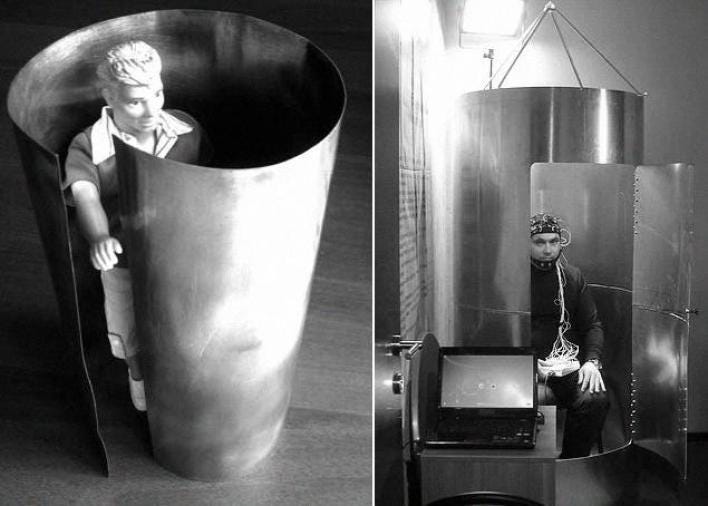
These mirrors are said to display the property of altering the flow of time and torsion fields by reflecting, focusing, and changing their properties.
One of the notable aspects of the Kozyrev mirror experiments was the observation that these mirrors exhibited anomalous behaviors.
For instance:
- Kozyrev noted that when an object was placed between two Kozyrev mirrors, its weight would fluctuate periodically. This phenomenon suggested a direct interaction between the object and the altered energy flows in the vicinity of the mirrors.
- The mirrors could affect the behavior of pendulums. When a pendulum was suspended in front of a Kozyrev mirror, it exhibited irregular oscillations and deviations from the expected patterns. This effect hinted at a disruption in the usual relationship between time and gravity, challenging the classical understanding of these phenomena.
- The volunteered subjects reported experience of time traveling, encountering with non-human entities, and physical manifestation of different symbols and items.
- After staying in these Kozyrev mirrors for a certain amount of time, the subjects reported a heightened sense of creativity, vitality, and mental focus. In addition to this, through Kyrian photography, the subjects’ auric field became more coherent and expanded as opposed to before entering these chambers.
- When he explored the impact of these mirrors on living organisms. He discovered that when a biological specimen, such as a plant or animal, was placed in front of the Kozyrev mirror, it would exhibit changes in growth patterns, physiological functions, and even altered rates of decay. These findings suggested that the mirror’s influence extended beyond inanimate objects and could affect living systems as well.
In conclusion:
The Kozyrev mirrors can alter the properties of torsion fields, creating localized disruptions in spacetime. Others have speculated that the mirrors may somehow tap into and harness subtle etheric energy sources that are normally inaccessible.
While Kozyrev’s contributions to the understanding of time were innovative and thought-provoking. His theories and ideas have faced skepticism and controversy within the scientific community. Over time some of his theories have been proven to be accurate, and were actively and secretly investigated by the CIA.
Nevertheless, his work has inspired ongoing research into the properties of time, torsion fields, and their potential implications for various fields of study.
Especially in Russia, if you choose to explore the idea further, there are many communities, institutions and hobbyist building and giving out blueprints for these mirrors.
Below is a Russian documentary about Kozyrev mirrors.
Did Nikolai A. Kozyrev Built a Time Machine?
The Soviet scientist who understood the nature of time
Introduction:
Nikolai Alexandrovich Kozyrev (1908–1983) was a prominent Russian astronomer, astrophysicist, and pioneer in the field of time research. Kozyrev’s groundbreaking experiments and theories challenged conventional scientific understanding and explored the interconnectedness of time, space, and energy.
His work has had a profound influence on fields such as cosmology, physics, and parapsychology. This article delves into the life, experiments, and contributions of Nikolai A. Kozyrev.
Kozyrev’s Life and Work
Nikolai Kozyrev was born on September 2, 1908, in Saint Petersburg, Russia. From an early age, he displayed a keen interest in natural sciences and pursued his passion for understanding the mysteries of the universe. In 1925. Kozyrev’s insatiable curiosity led him to explore various scientific disciplines, including astronomy and astrophysics.
In his studies he pursues astronomy and physics and graduated from Leningrad State University in 1931 with a degree in astrophysics. He became a professor at the Pulkovo Observatory, where he studied stellar spectra and variable stars.
In 1936, he was arrested by the Soviet authorities for his involvement in a political opposition group and spent 11 years in prison camps and exile. During this time, he continued to study physics and astronomy, and developed his ideas on time energy and non-equilibrium thermodynamics.
After his release in 1947, he returned to the Pulkovo Observatory, where he resumed his research on variable stars. He also began to conduct experiments on the effects of time energy on physical phenomena, such as weight, pendulum motion, electrical resistance, light polarization, and nuclear decay.
According to Kozyrev, through his experiments he detected a new form of energy that emanated from stars and other sources, which he called “time energy” or “torsion fields”. He believed that this energy was related to the flow of time, and that it could create or destroy matter and gravity. He also postulated that this energy (torsion fields) could be influenced by human consciousness and intention.
He devised various instruments to measure and manipulate this energy, such as mirrors, coils, gyroscopes, quartz crystals, and pyramids. He reported various anomalous results from his experiments, such as changes in weight, acceleration, temperature, electrical resistance, light polarization, nuclear decay rates, and biological processes.
He also developed a theory of non-equilibrium thermodynamics, which challenged the second law of thermodynamics and the concept of entropy.
He argued that systems could spontaneously move away from equilibrium and increase their order and complexity by absorbing time energy from their environment.
He applied this theory to explain various phenomena in astronomy and cosmology, such as stellar evolution, galaxy formation, dark matter, dark energy, and the origin and fate of the universe.
Key factors of Kozyrev’s understanding of nature of time:
Here are some of the properties of time proposed by Nikolai A Kozyrev.
- Active Energy: Kozyrev viewed time as an active force with its own energy, challenging the conventional perception of time as a passive concept.
- Torsion Fields: Kozyrev proposed that time’s energy manifested as torsion fields, which possessed a spiraling, twisting nature. These fields interacted with matter, space, and other forms of energy, influencing their behavior.
- Correlation with Solar Activity: Kozyrev observed a correlation between solar activity and the behavior of torsion fields, suggesting that solar energy fluctuations had an impact on the properties of time.
- Non-Locality: Kozyrev postulated that time possessed non-local properties, enabling it to exert its influence beyond specific locations in space. This perspective challenged the traditional linear understanding of time, suggesting it could transcend spatial limitations.
- Malleability: Kozyrev’s experiments with Kozyrev mirrors demonstrated that the flow of time and energy could be altered or manipulated, resulting in anomalous effects on physical systems and living organisms.
- Potential Influence of Consciousness: Kozyrev hypothesized that consciousness and focused human intention might interact with torsion fields, potentially affecting the flow of time.
Kozyrev Mirror Experiments:
Nikolai A. Kozyrev also conducted a series of experiments involving what he called “Kozyrev mirrors.” These experiments aimed to investigate the effects of special types of mirrors on the flow of time and energy.
The Kozyrev mirrors were made by a spiral cylindrical structure of concave and reflective aluminum sheets, or metal plates.
Kozyrev mirrors are enclosed chambers that block external radiation and are large enough for individuals to enter and lock themselves inside. They alter the flow of time and torsion fields by reflecting, focusing, and changing their properties.
These mirrors are said to display the property of altering the flow of time and torsion fields by reflecting, focusing, and changing their properties.
One of the notable aspects of the Kozyrev mirror experiments was the observation that these mirrors exhibited anomalous behaviors.
For instance:
- Kozyrev noted that when an object was placed between two Kozyrev mirrors, its weight would fluctuate periodically. This phenomenon suggested a direct interaction between the object and the altered energy flows in the vicinity of the mirrors.
- The mirrors could affect the behavior of pendulums. When a pendulum was suspended in front of a Kozyrev mirror, it exhibited irregular oscillations and deviations from the expected patterns. This effect hinted at a disruption in the usual relationship between time and gravity, challenging the classical understanding of these phenomena.
- The volunteered subjects reported experience of time traveling, encountering with non-human entities, and physical manifestation of different symbols and items.
- After staying in these Kozyrev mirrors for a certain amount of time, the subjects reported a heightened sense of creativity, vitality, and mental focus. In addition to this, through Kyrian photography, the subjects’ auric field became more coherent and expanded as opposed to before entering these chambers.
- When he explored the impact of these mirrors on living organisms. He discovered that when a biological specimen, such as a plant or animal, was placed in front of the Kozyrev mirror, it would exhibit changes in growth patterns, physiological functions, and even altered rates of decay. These findings suggested that the mirror’s influence extended beyond inanimate objects and could affect living systems as well.
In conclusion:
The Kozyrev mirrors can alter the properties of torsion fields, creating localized disruptions in spacetime. Others have speculated that the mirrors may somehow tap into and harness subtle etheric energy sources that are normally inaccessible.
While Kozyrev’s contributions to the understanding of time were innovative and thought-provoking. His theories and ideas have faced skepticism and controversy within the scientific community. Over time some of his theories have been proven to be accurate, and were actively and secretly investigated by the CIA.
Nevertheless, his work has inspired ongoing research into the properties of time, torsion fields, and their potential implications for various fields of study.
Especially in Russia, if you choose to explore the idea further, there are many communities, institutions and hobbyist building and giving out blueprints for these mirrors.
Leave a Reply