
Universe
How is Everything a Vibration?
The Universe of Frequencies and Vibration
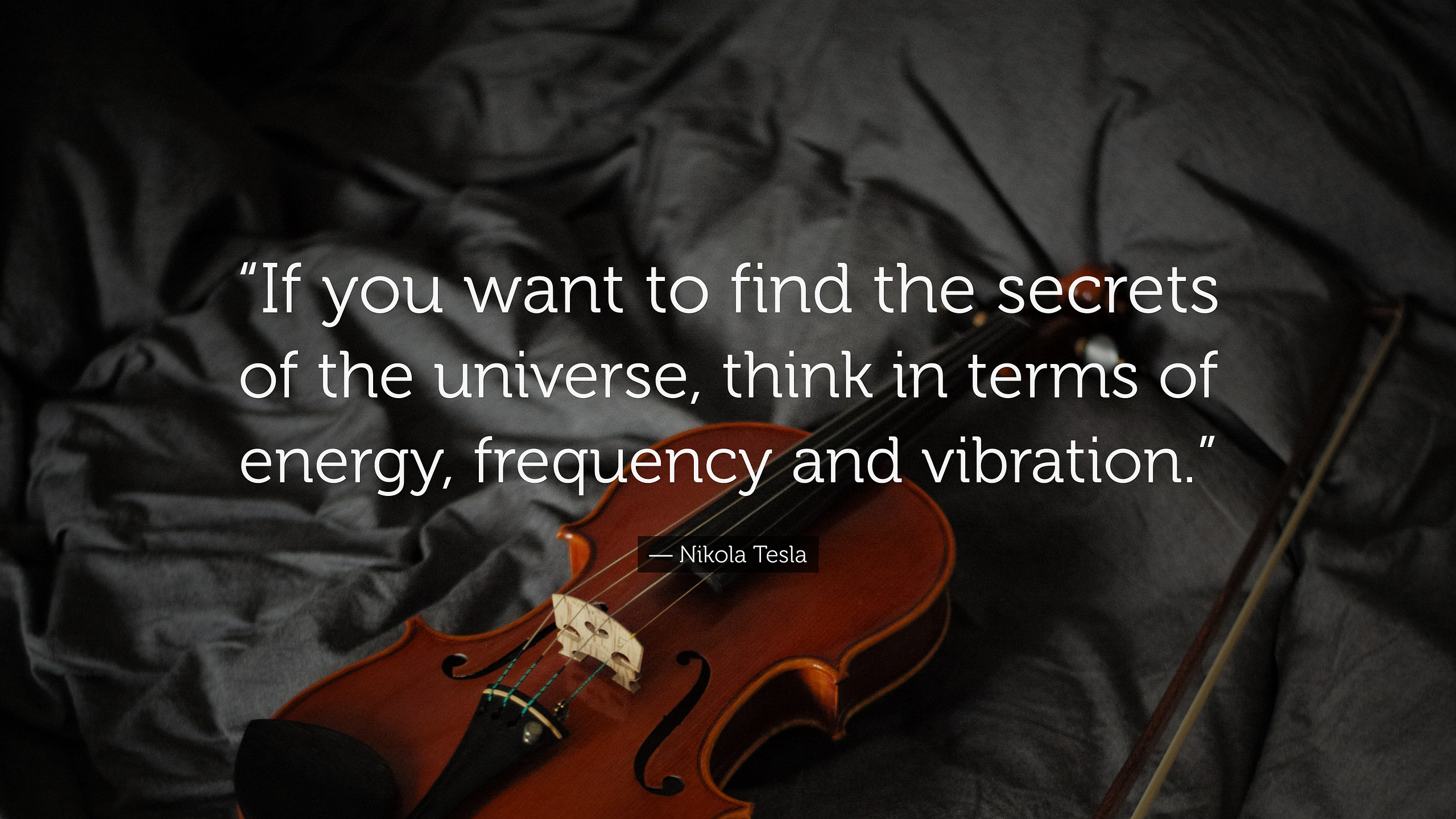
“If you want to find the secrets of the universe, think in terms of energy, frequency, and vibration.”
― Nikola Tesla
Our physical world is experienced through our five senses: touch, sight, hearing, smell, and taste.
What is vibration? A vibration is a repetitive movement. For example, a plucked guitar string vibrates. Frequency is how often this movement repeats over time. If you walk 20 feet and return in 5 minutes, your frequency is 20 feet per 5 minutes. Wavelength is the total distance of one complete vibration (20 feet in this case), and amplitude is half that distance (10 feet).
Ultimately, our reality is a mental construct based on perception. It’s created by our consciousness, not an objective truth.
Consciousness as a Constructor of Realitybroaderperspective.space
Vibration and frequencies on our five senses.
- Sight: Light is electromagnetic radiation that travels in waves. Different wavelengths of light correspond to different colors we perceive. For example, red light has a longer wavelength than blue light. When light interacts with objects, it can be absorbed, reflected, or refracted. These interactions cause vibrations in the object’s atoms and molecules, which our eyes detect as variations in color and brightness.
- Hearing: Sound waves are created by vibrating objects. These vibrations travel through air (or other media) as compression waves. When these waves reach our ears, they cause our eardrums to vibrate. The frequency of these vibrations determines the pitch we hear, while the amplitude affects the volume.
- Smell: Odor molecules interact with olfactory receptors in our nasal passages. At a molecular level, this interaction involves the vibration of chemical bonds. Different molecules have different vibrational frequencies, which our brain interprets as distinct smells. This is known as the vibrational theory of olfaction.
- Taste: Taste receptors on our tongue detect dissolved chemicals in food and drink. Similar to smell, the interaction between taste molecules and receptors involves vibrational energy at the molecular level. The specific vibrational patterns of different molecules contribute to the five basic tastes: sweet, sour, salty, bitter, and umami.
- Touch: At the atomic level, what we perceive as “solid” matter is mostly empty space. The sensation of touch is created by electromagnetic repulsion between the electrons in our skin and those in the object we’re touching. These electrons are in constant motion, creating a vibrating “electron cloud” around atoms. When two objects come close, these electron clouds repel each other, creating the sensation of touch.
In quantum physics, all particles exhibit wave-like properties (wave-particle duality). This means that at the most fundamental level, everything in the universe can be described in terms of vibrations and frequencies. Our sensory systems have evolved to detect and interpret these vibrations, allowing us to perceive and interact with the world around us.
In conclusion our experience of a “solid” physical world is, in fact, an interpretation of complex patterns of vibrations and frequencies by our consciousness. This emphasizes the subjective nature of our reality and the role that perception plays in shaping our perception of our surroundings.
Universe
How is Everything a Vibration?
The Universe of Frequencies and Vibration
“If you want to find the secrets of the universe, think in terms of energy, frequency, and vibration.”
― Nikola Tesla
Our physical world is experienced through our five senses: touch, sight, hearing, smell, and taste.
What is vibration? A vibration is a repetitive movement. For example, a plucked guitar string vibrates. Frequency is how often this movement repeats over time. If you walk 20 feet and return in 5 minutes, your frequency is 20 feet per 5 minutes. Wavelength is the total distance of one complete vibration (20 feet in this case), and amplitude is half that distance (10 feet).
Ultimately, our reality is a mental construct based on perception. It’s created by our consciousness, not an objective truth.
Consciousness as a Constructor of Realitybroaderperspective.space
Vibration and frequencies on our five senses.
- Sight: Light is electromagnetic radiation that travels in waves. Different wavelengths of light correspond to different colors we perceive. For example, red light has a longer wavelength than blue light. When light interacts with objects, it can be absorbed, reflected, or refracted. These interactions cause vibrations in the object’s atoms and molecules, which our eyes detect as variations in color and brightness.
- Hearing: Sound waves are created by vibrating objects. These vibrations travel through air (or other media) as compression waves. When these waves reach our ears, they cause our eardrums to vibrate. The frequency of these vibrations determines the pitch we hear, while the amplitude affects the volume.
- Smell: Odor molecules interact with olfactory receptors in our nasal passages. At a molecular level, this interaction involves the vibration of chemical bonds. Different molecules have different vibrational frequencies, which our brain interprets as distinct smells. This is known as the vibrational theory of olfaction.
- Taste: Taste receptors on our tongue detect dissolved chemicals in food and drink. Similar to smell, the interaction between taste molecules and receptors involves vibrational energy at the molecular level. The specific vibrational patterns of different molecules contribute to the five basic tastes: sweet, sour, salty, bitter, and umami.
- Touch: At the atomic level, what we perceive as “solid” matter is mostly empty space. The sensation of touch is created by electromagnetic repulsion between the electrons in our skin and those in the object we’re touching. These electrons are in constant motion, creating a vibrating “electron cloud” around atoms. When two objects come close, these electron clouds repel each other, creating the sensation of touch.
In quantum physics, all particles exhibit wave-like properties (wave-particle duality). This means that at the most fundamental level, everything in the universe can be described in terms of vibrations and frequencies. Our sensory systems have evolved to detect and interpret these vibrations, allowing us to perceive and interact with the world around us.
In conclusion our experience of a “solid” physical world is, in fact, an interpretation of complex patterns of vibrations and frequencies by our consciousness. This emphasizes the subjective nature of our reality and the role that perception plays in shaping our perception of our surroundings.
Leave a Reply